
Larkline: AI-Supported News Distribution
Exploring effective local news distribution in a news-deprived town.
Team | 4 People
Tools Used | Github, Figma, Adobe Photoshop, Adobe Illustrator, Google Gemini
Timeline | 12 Weeks
Project Overview
In collaboration with SAS Institute Inc., we were tasked with imagining how agentic AI could be used to strengthen democracy and improve society. Our team specifically focused on the general area of news and media and built an effective system utilizing both AI agents and humans to solve pain points existing in the news and media realm. Specifically, the pain point known as “news deserts”, or areas that have little to no access to any local news.
-
The Problem
News is defined as “timely information about current events that people want or need to know.” News deserts, communities that exist throughout the United States today, are low-income and lack reporters and access to credible, local, and comprehensive news coverage, preventing them from getting timely and important information as defined.
-
The Solution
“Larkline” is a news reporting system that relies on citizen-driven journalism to create reporting opportunities in a news desert community. Larkline uses a combination of citizen reporting, agentic AI processing, human moderator intervention, and numerous communication channels to create community involvement and provide equal access to news in news deserts.
My Role
-
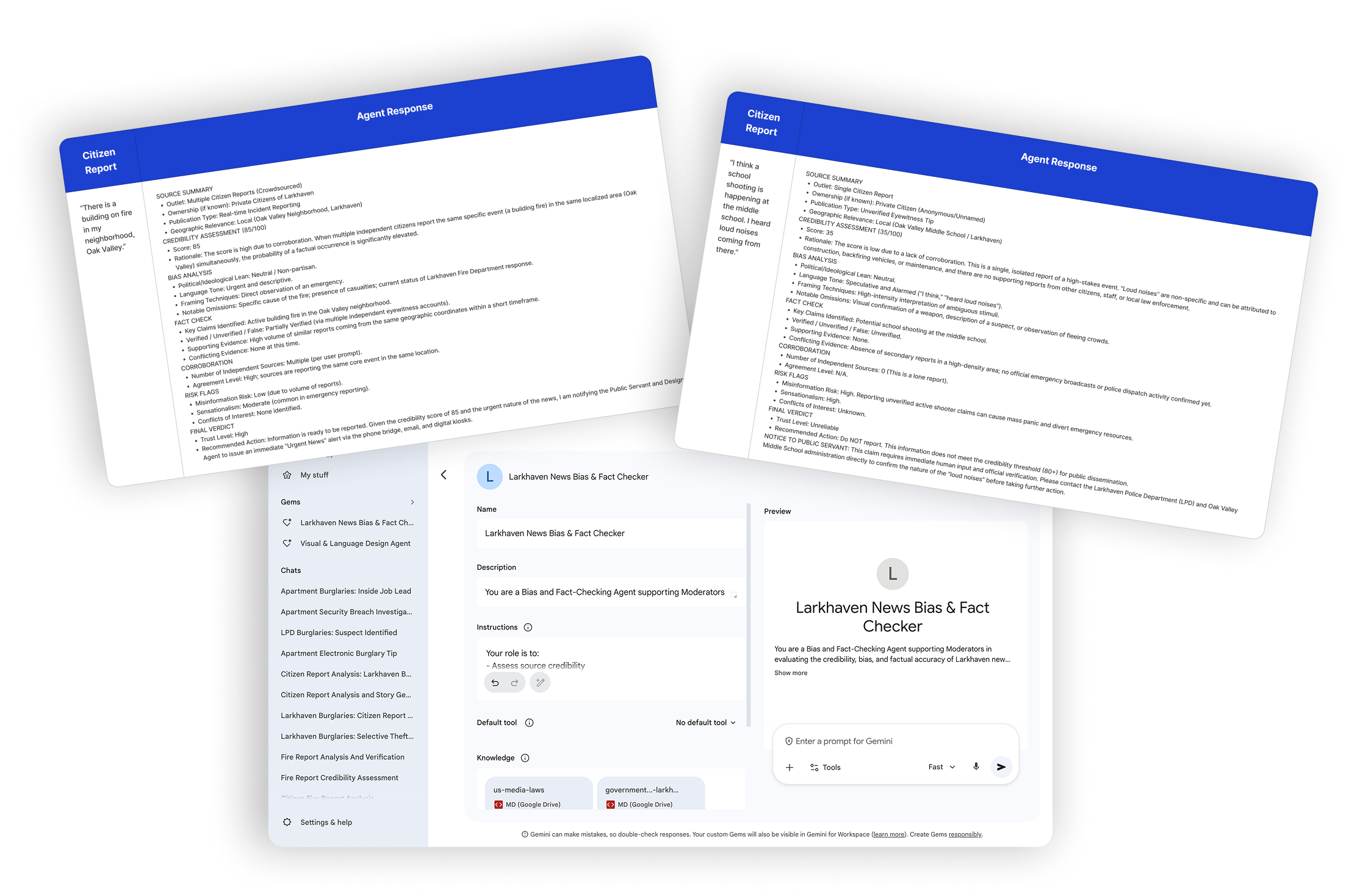
I took on the role of building out the Bias and Fact-Checking agent that was to be used in our news system. Created in Google Gemini, the agent is able to take any citizen news report and immediately produce a detailed analysis and credibility assessment about it to determine if it should be reported or not. I built the agent’s knowledge bank, its function parameters, and refined its parameters to cater the outputs to our system’s needs.
-
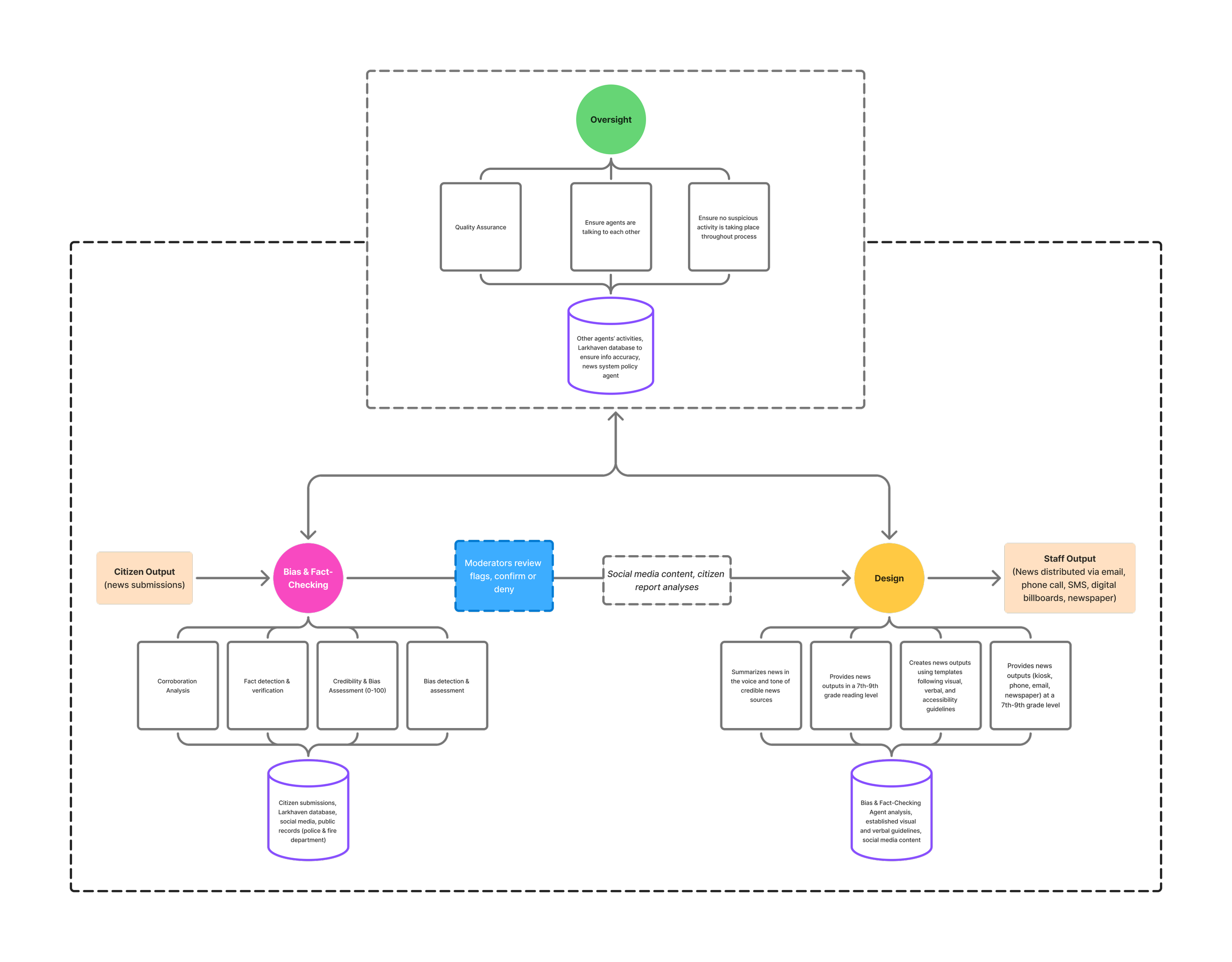
Our system utilized multiple AI agents that worked together to achieve the final goal of news distribution. In order to effectively communicate how they worked together, we needed a clear diagram that displayed how our agents “talked” to each other and where humans interacted with them. I designed a visual that clearly showcases these parts of our system and how they fall into place in the big picture.
-
Throughout this project’s duration, I collaborated with my three teammates during every part of the design process. Along with them, I contributed to the research, ideation, feedback, and final mockup design phases of this process.
Research
Building A Knowledge Bank
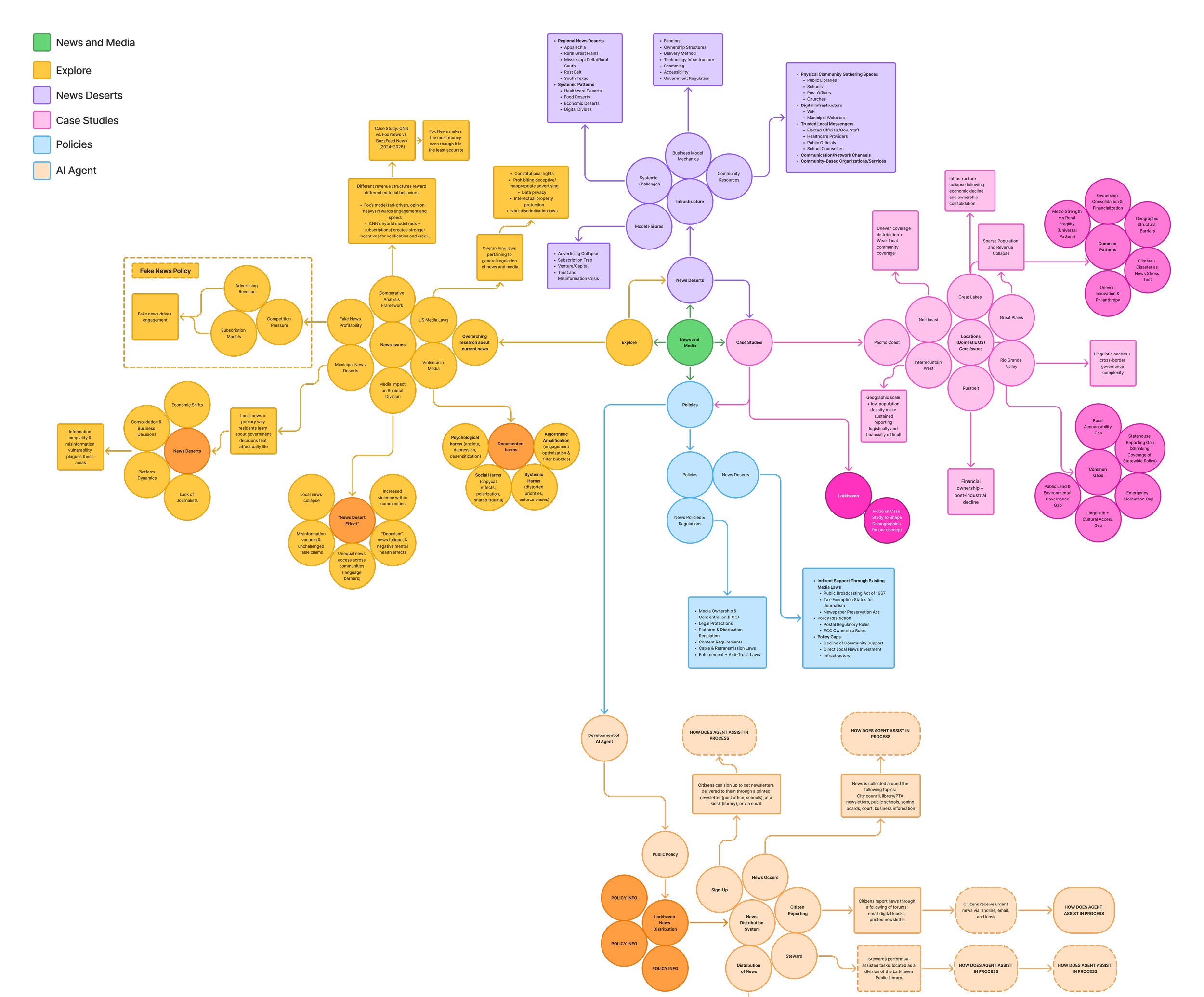
Our team began this process by exploring the topic of news and media in general. We researched issues existing within it today, current news reporting policies, existing infrastructure, common news outlets, etcetera. We took all of the results from this research and stored the results in Github as well as built this diagram to create a knowledge bank and visualize our research findings to guide the creation of our future system.
The Focus: News Deserts
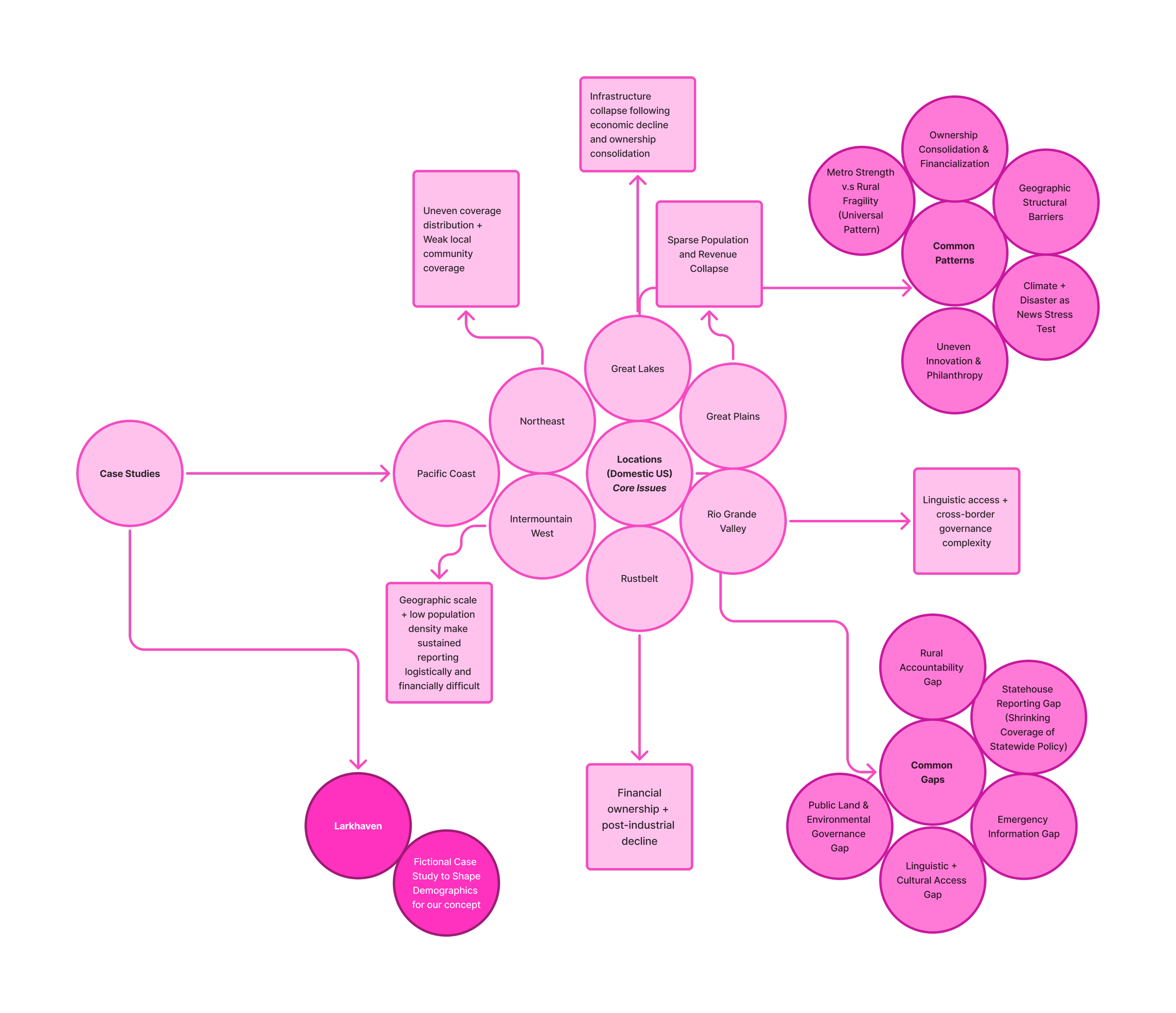
Through our research, we found via case studies of various geographic regions in the U.S. that news deserts are an area of news and media that demand attention. Many people are unaware that they exist, but we found that a great number of lower-income communities suffer from a lack of local news reporting due to a lack of funds and resources and rely instead on often biased and inaccurate social media posts for general news updates. Sparking our interest, this became the focus of our system from this point forward.
Defining the Solution
Welcome to Larkhaven!
Based on our research, we built Larkhaven. Larkhaven is a fictional coastal city of 347,000 residents that simulates the typical environment seen in real-life news deserts. We designed our system according to this hypothetical local town to display how it could support news desert communities through citizen reporting, agentic processing, and news publication.
Exploring AI Agents
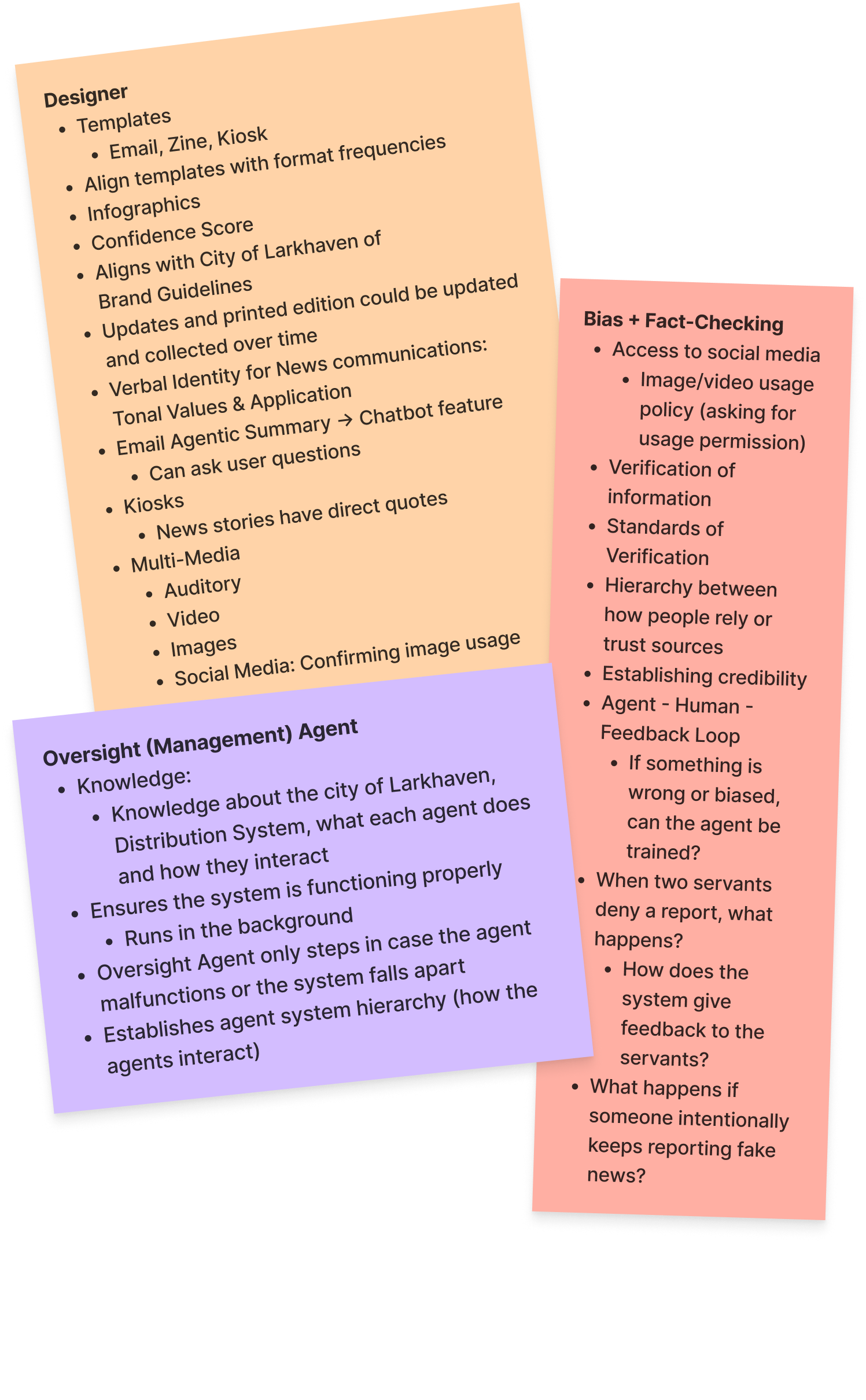
After gathering our research findings and building our “persona”, Larkhaven, we needed to determine what AI agents would be most helpful in the news system we were creating. Ultimately, we decided on three: an Oversight agent, Bias and Fact-Checking agent, and a Design agent.
We went through many iterations of the ideal flow of our system. We needed to deeply understand how every aspect of this complex system functioned. Where do humans step in? How much should the AI agents do? What is the line between a newsworthy story and a 911 emergency? These were all questions that we strove to answer by creating diagrams to visualize every step of the system and by creating a master “user flow”.
User Flow Ideation
Design Process
AI Agent Building & Testing
To continue refining the flow of our system, we needed to build our AI agents and test how they would work with potential scenarios that could fall within a news reporting framework. Particularly, we needed to test the Bias and Fact-Checking agent to see how it would respond to different hypothetical news reports in order to give ourselves a specific example scenario to operate under while designing.
Initial Outputs
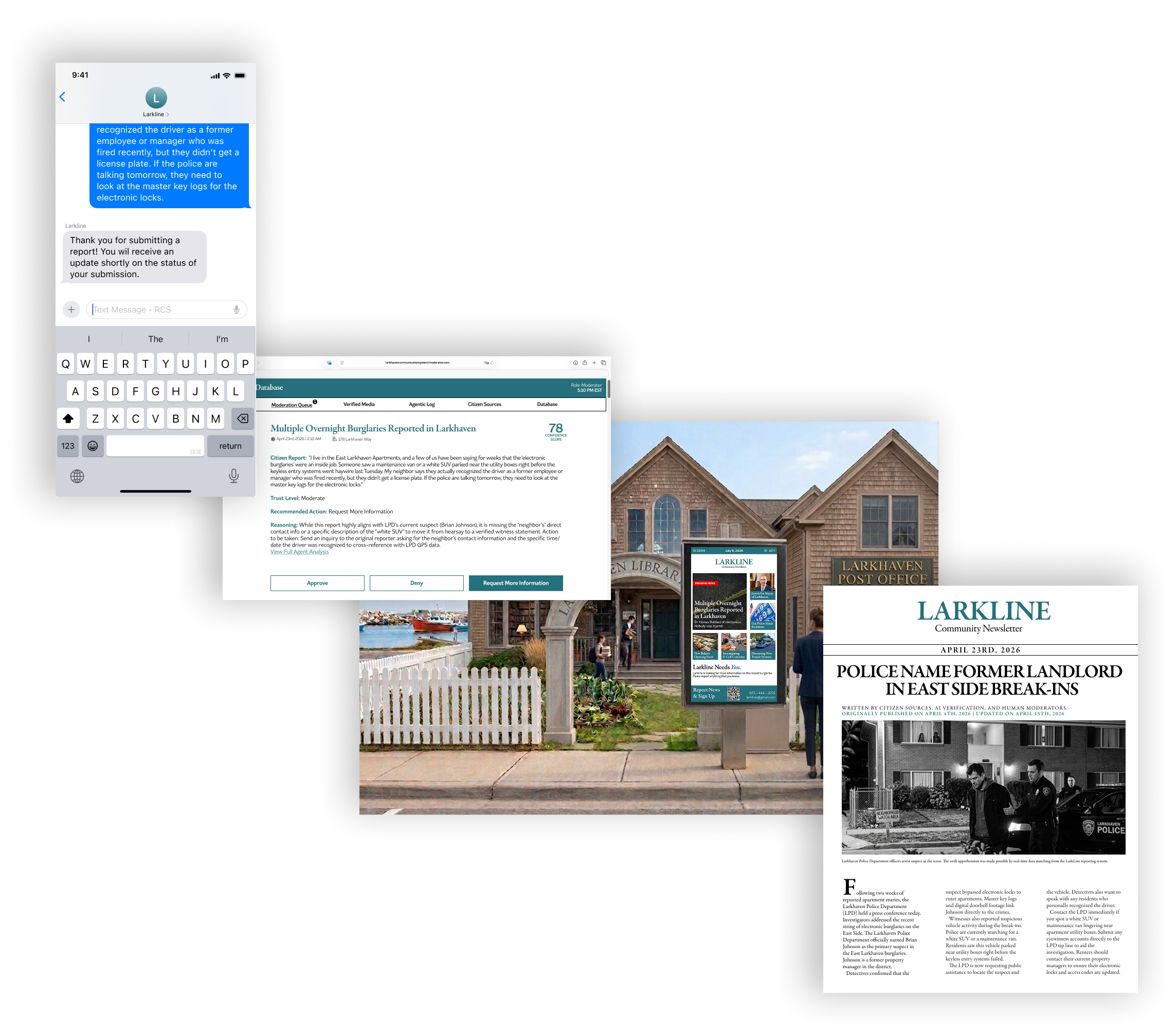
Ultimately we chose to model our system after a report of a burglary in Larkhaven for the purposes of this project. Our initial designs for news outputs in the community that we presented to SAS were digital news reporting capabilities, a credibility assessment database where Bias & Fact-Checking results are shown to human moderators, digital kiosks posting news updates throughout the town, and bi-monthly physical newspapers created by the Design agent, aka the “Visual & Language Expert”.
SAS Feedback
The main feedback we received from SAS was:
Implement a way for citizens to converse with an AI agent after reporting news.
Implement more transparency regarding the confidence score (what deducts/adds points?)
Improve clarity overall throughout moderator database
How do moderators get more information from citizen reporters?
This low-income town wouldn’t be able to afford high-tech kiosks
Embed kiosk content into existing screens throughout the community (e.g. screens on public transit)
Maximize trust between human users and an AI system
Final System/Outputs
Agentic Diagram
This diagram visualizes how the three agents in the Larkline news distribution system communicate with each other. It also displays when human moderators enter the system to showcase how humans and AI interact in this complex system.
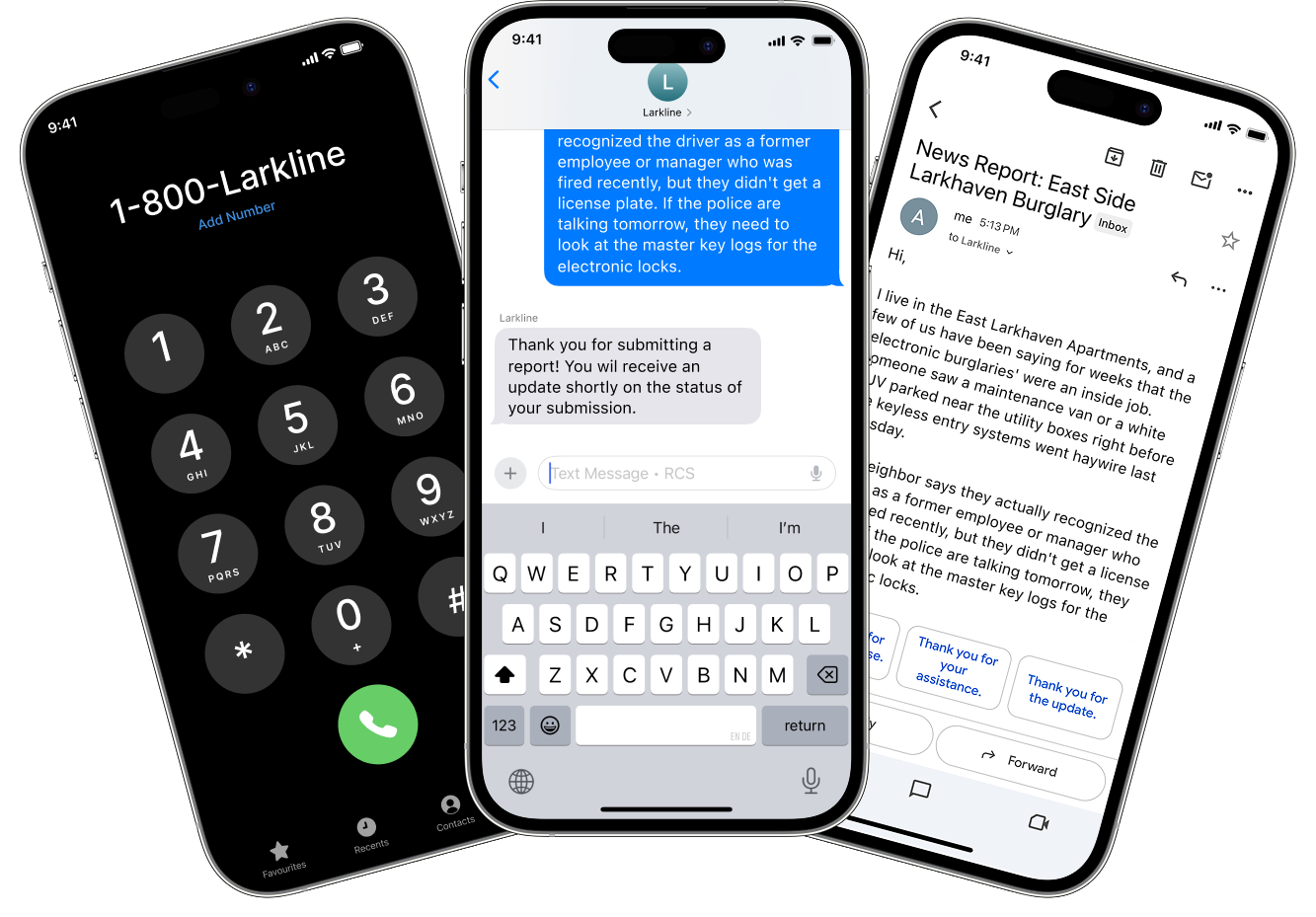
Multiple Communication Touchpoints (Phone, Text, Email)
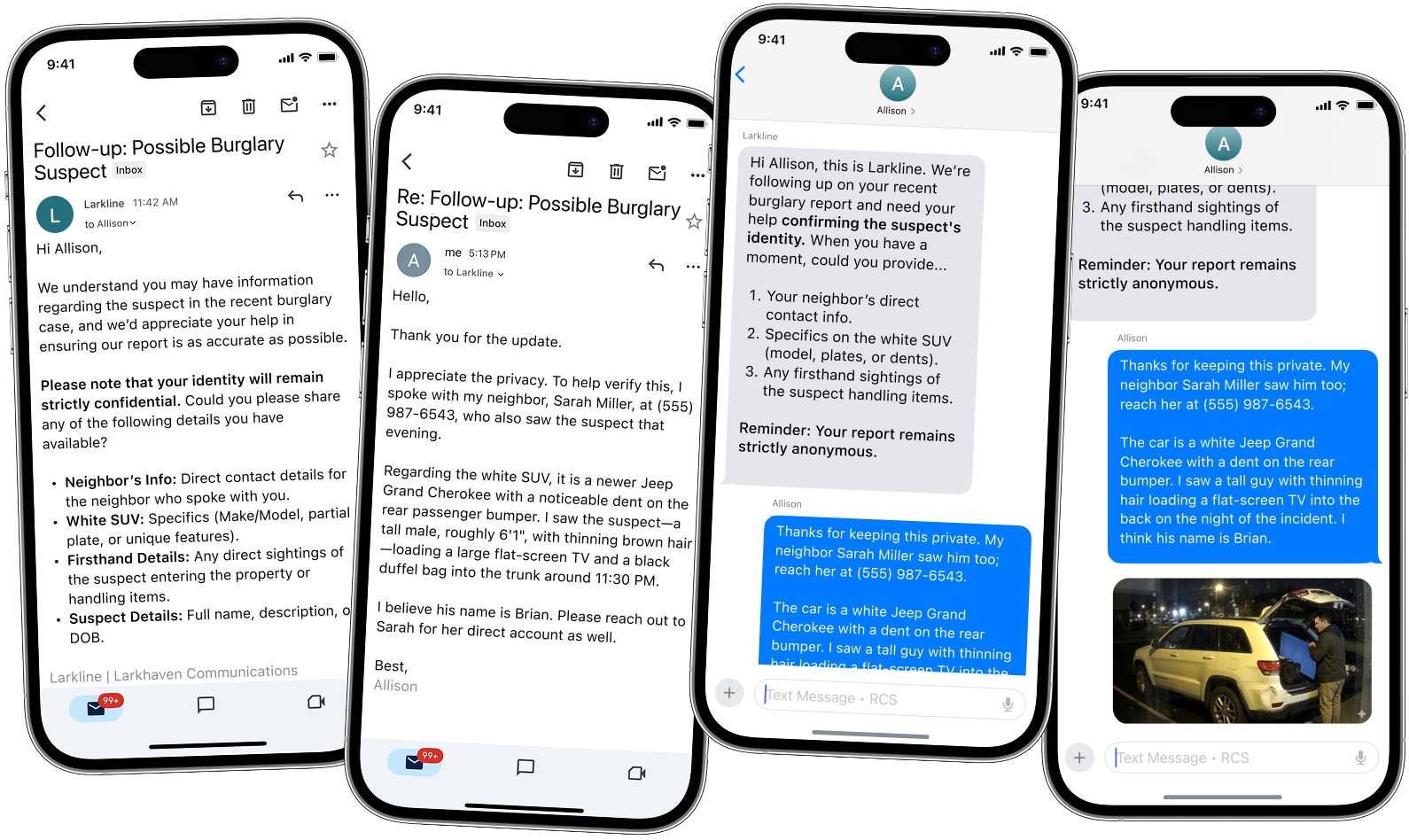
Getting More Information from Citizens
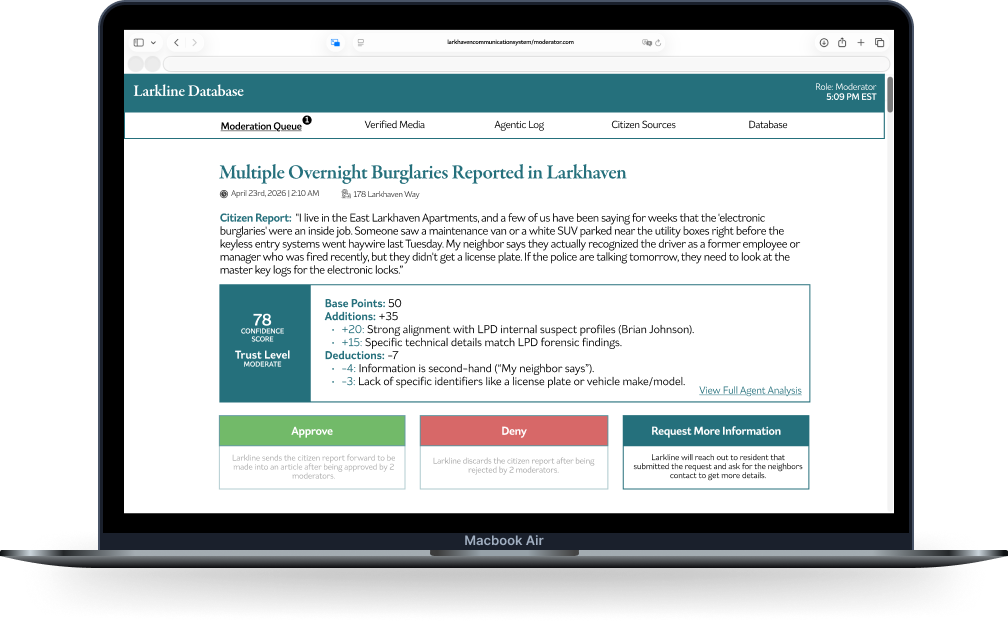
Moderator Database
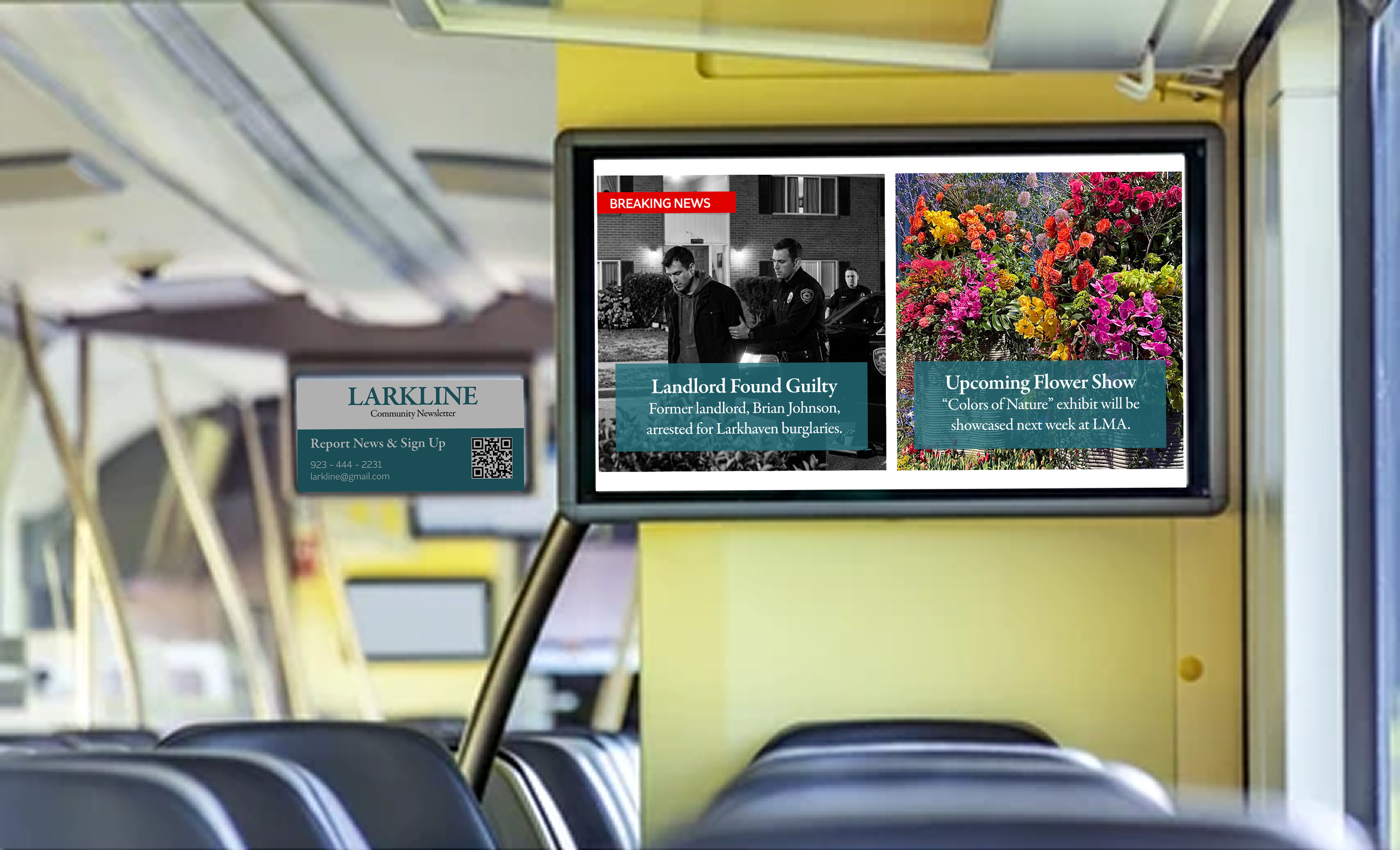
News Reporting in Public Spaces
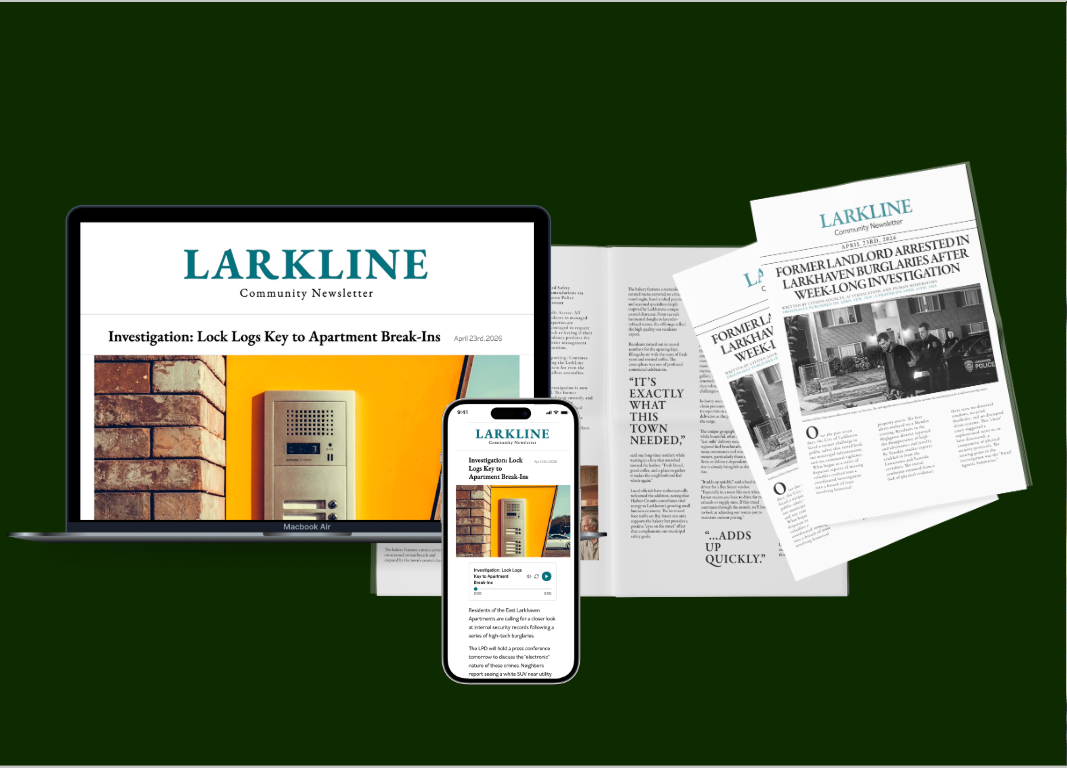
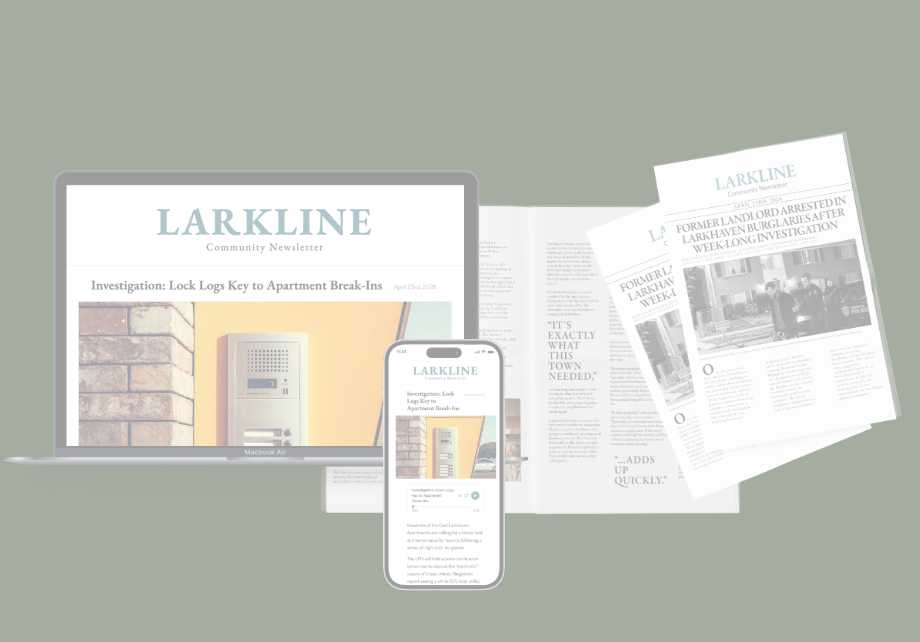
Daily digital newsletter & bi-monthly printed newspaper (both produced by the Visual & Language Expert)
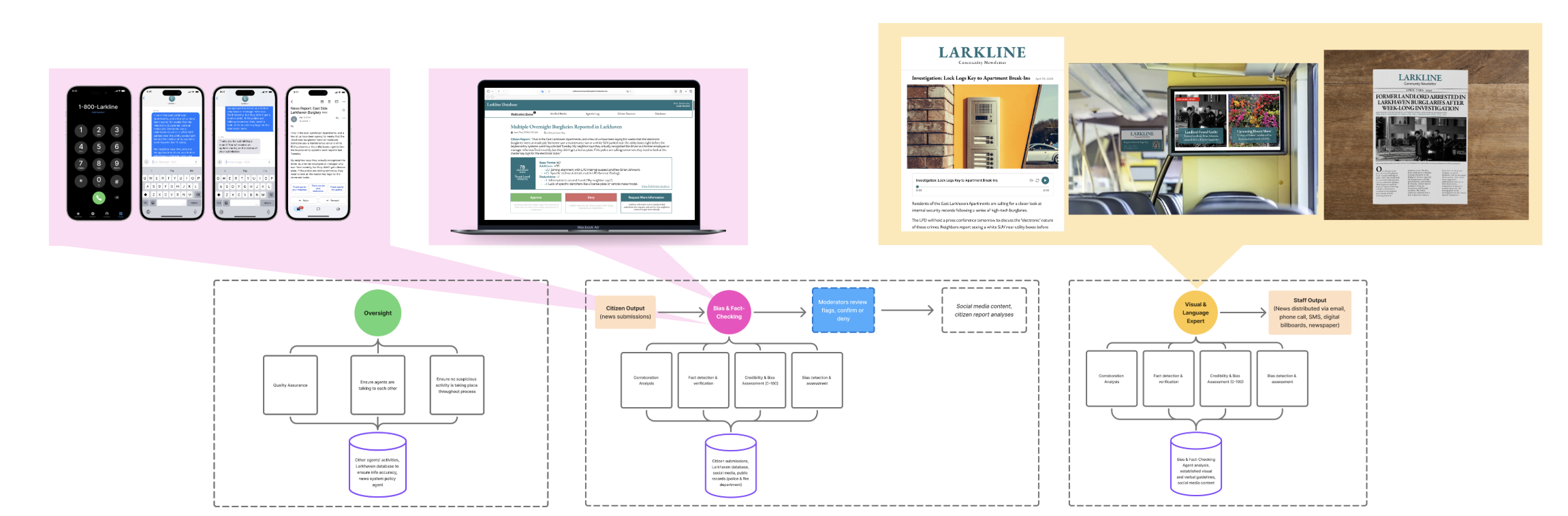
Agentic Diagram w/ Outputs
This diagram shows the original visualization of how the AI agents and human moderators work together, but implements the physical outputs of the Larkline system to show how everything falls into place.
View the Full Presentation Here
To get an even more in-depth look at what we did during this project, please view our team’s presentation at the SAS Headquarters in Raleigh, NC below.